A bookkeeper in Winnipeg needs to finish payroll, but the only machine with the accounting file is a PC at the office, and it’s powered off. A site manager in Calgary can’t open the estimating software from the field because it lives on a server in head office. A three-person law practice in Halifax has client files scattered across laptops, and nobody is sure which copy is current.
None of these is an unusual problem. They all come from the same setup: the work lives on specific machines in a specific building. Remote desktop hosting solves it by moving the work environment onto managed infrastructure that employees can reach from anywhere.
This guide explains how remote desktop hosting works, how it compares with a VPN, what Canadian businesses should check before choosing a provider, and what the move involves.
What is remote desktop hosting?
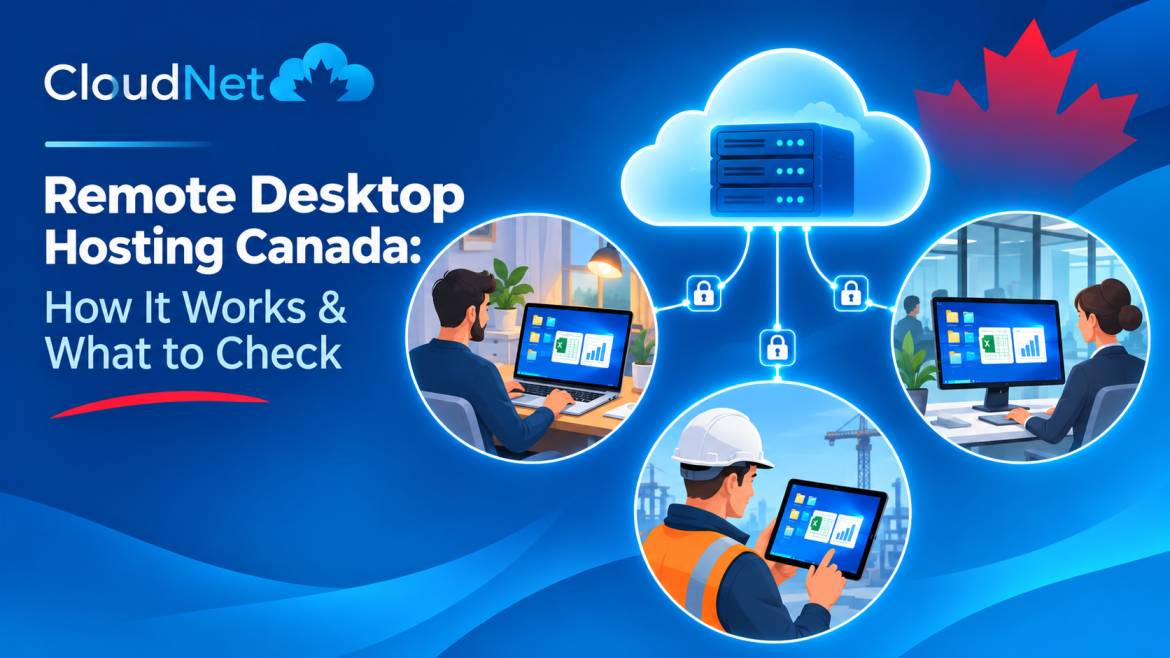
Remote desktop hosting gives your team secure access to a Windows desktop that runs on a provider’s managed servers, not on a computer in your office. Employees log in from a laptop, a home PC or a tablet and see the same desktop, applications and files every time.
A provider typically manages the following for you:
- Windows desktops: a full Windows environment in a centrally managed setup
- Business applications: accounting, ERP, tax, legal, construction, inventory and custom Windows software
- Company files: shared folders in one place instead of spread across laptops
- Printing: many local and network printers can be supported and tested before go-live
The point is consistency. Applications, data and security all sit in one managed place, so the office isn’t the single point of failure.
How remote desktop hosting works
- Your applications and data move to a hosted environment. The provider builds and runs the servers, and handles updates, security, backups and support.
- Each employee gets their own login and profile. Permissions decide which applications and folders each person can see.
- Employees connect over the internet from approved devices. Only the screen, keyboard and mouse activity travel between the device and the hosted desktop. The work itself happens on the provider’s infrastructure.
- The provider keeps everything running. That includes patching, monitoring, multi-factor authentication, firewall management and backups.
Because the heavy lifting happens on the server, even an older laptop can run demanding applications.
Remote desktop hosting vs VPN vs remote-controlling an office PC
Most businesses try the cheaper options first. Here’s how they compare.
| VPN | Remote-controlling an office PC | Remote desktop hosting | |
|---|---|---|---|
| Where the work happens | Back on your office network | On one specific office computer | On managed hosted infrastructure |
| Depends on the office | Yes: internet, servers, power | Yes: that PC must be on, online and working | No |
| Consistent environment | Depends on each employee’s device | Only for the one person using that PC | Same desktop from any approved device |
| Backups and security | You manage them | You manage them | Centrally managed |
| Scales to more users | You maintain the infrastructure | Becomes unmanageable quickly | Add users as you grow |
A VPN usually connects the employee back to your existing office network. You’re still reliant on the office internet staying up, physical servers staying healthy and local PCs being switched on. Remote-controlling an office PC has the same weakness: that one machine must stay powered, connected and maintained. Hosted desktops move the environment off the building, so the office no longer matters to whether people can work.
Three ways to deliver a hosted desktop
“Remote desktop hosting” is the broad service. Underneath, a provider can deliver it in different ways, and a good one will recommend the right fit rather than make you choose up front.
- Hosted RDS (Remote Desktop Services): multiple employees share a managed Windows Server environment, each with their own session and profile. It’s cost-efficient and works well when staff use similar applications.
- VDI hosting (Virtual Desktop Infrastructure): each user gets an individual virtual desktop with dedicated resources. It suits users who need different configurations, more isolation or specialized workloads. (Our guide to DaaS and VDI in Canada goes deeper.)
- Windows Cloud PCs: individually assigned Microsoft cloud desktops, for teams that prefer that model.
A quick rule of thumb: if your team uses the same handful of applications and cost matters, RDS is often the starting point. If people need their own isolated desktops, look at VDI or Cloud PCs.
Who benefits most
Remote desktop hosting makes the most difference for teams with several of these traits:
- Remote or hybrid employees
- Multiple office locations
- A physical Windows server that’s ageing or hard to support
- Windows business applications used every day
- A wish to put everyone on the same systems
- No in-house IT person to manage remote-access infrastructure
In practice, that often means:
- Accounting and bookkeeping firms running QuickBooks, Sage and tax software (see our QuickBooks remote access hosting guide)
- Law firms that need client files and practice-management software reachable from court, home or travel (see cloud servers for law firms)
- Construction and restoration companies with estimators and project managers in the field (see cloud hosting for construction)
- Manufacturers and distributors whose ERP and inventory systems can’t afford downtime (see cloud hosting for manufacturing and retail)
Canadian considerations: privacy, data location and support
Moving work to a provider doesn’t move your responsibility for the data. A few points matter for Canadian organizations.
You stay accountable. Handing personal information to a third party doesn’t hand off responsibility; under PIPEDA, the organization remains accountable for how the provider handles it. PIPEDA doesn’t prohibit storing information outside the country, but you’re expected to make sure it stays protected with the provider. mondaqcba
Quebec and Alberta have extra rules. Alberta’s PIPA requires organizations to tell individuals when a service provider outside Canada is used to process their personal data. Quebec’s Law 25 requires a privacy impact assessment before personal information is transferred outside Quebec. “Canadian” isn’t enough for Quebec: a provider hosting in another province can still trigger that assessment. If you have Quebec employees or customers, ask where your data will sit and get the answer in writing. bakermckenziehilotech
Ask these questions before you sign:
- Where is my data hosted, and where is it backed up?
- Who has administrative access to my environment?
- Which sub-processors touch my data?
- Will you sign a contract that covers privacy and security obligations?
This section is general information, not legal advice. If you handle sensitive client or health information, speak to your lawyer or privacy officer.
Support hours matter too. Canada spans six time zones. A provider with 24/7 technical support means a staff member in Vancouver at 7 a.m. gets the same help as one in St. John’s mid-afternoon.
What to look for in a remote desktop hosting provider
Use this checklist when comparing providers.
Security
- Multi-factor authentication on every login
- Managed firewall and endpoint protection with monitoring
- Regular patching and updates handled by the provider
Continuity
- Managed backups with monitoring, and recovery support
- A written uptime guarantee (an SLA)
- A disaster recovery plan for your environment (see our disaster recovery guide for Canadian small businesses)
Applications and licensing
- Confirmation that your specific software is compatible, including databases and legacy tools
- Clarity on who supplies Microsoft licensing, and what it costs, before deployment
- Printing tested before go-live, especially for specialized devices
People
- Migration assistance, so you aren’t left to move servers yourself
- Technical support included in the plan, not billed per call
- User onboarding and offboarding handled promptly
Flexibility
- The ability to add users as you grow
- A provider that can deliver RDS, VDI or Cloud PCs, so you aren’t forced into one model
What affects the cost?
Remote desktop hosting is usually priced around your actual environment, not a one-size-fits-all rate. The main factors are:
- Number of users
- Technology model: shared RDS typically costs less per user than dedicated VDI desktops
- Resources per user: CPU, memory and storage for heavier applications
- Applications and databases that need to be hosted
- Microsoft licensing, such as Office, if you need it supplied rather than bringing your own
- Support and backup level in the service plan
Be wary of any provider that quotes a price without asking what you run. Compatibility and licensing have to be validated first. Add up the full monthly cost, including licensing, backups and support, before you compare.
What migration looks like?
Moving off an office server is less daunting when the provider handles it. A typical process looks like this:
- Assessment. The provider reviews your current server, users, applications, storage, databases, network drives, printers and backups.
- Plan. You agree on the right delivery model (RDS, VDI or Cloud PCs) and a migration plan.
- Build and migrate. The environment is set up, applications and data are moved, and security is configured.
- Test. Logins, applications, file access and printing are checked before anyone depends on them.
- Onboard. Users get access, and support is available as the team settles in.
Ask any provider how long each stage takes and what you need to do on your side.
Common mistakes to avoid
- Treating a VPN as a long-term fix. It extends your office network but doesn’t remove its weak points.
- Skipping licensing questions. Surprises on Microsoft licensing are one of the most common sources of unexpected cost.
- Not testing printers or specialized devices until the day after migration.
- Ignoring data location. Find out where your data sits before you sign, especially with Quebec or Alberta clients.
- Choosing on price alone. Cheap hosting without managed backups, security monitoring and real support can cost far more after an incident.
Why Canadian businesses choose CloudNet?
CloudNet is a Canadian-based provider of cloud-based IT management. For remote desktop hosting, that includes:
- Hosted desktops, applications and company files on managed infrastructure, accessible from any approved device
- RDS, VDI or Windows Cloud PCs, with a recommendation based on how your team actually works
- Support for 3,000+ applications, including QuickBooks, Sage, Microsoft Office, SQL-based software, tax, ERP, construction, legal and inventory applications
- Daily managed backups and a 99.9% uptime SLA
- 24/7 technical support and migration assistance as part of the service
- MFA, firewall management, endpoint protection and monitoring built in
Learn more on our Remote Desktop Hosting page, or see how Hosted RDS compares with other options.
Frequently asked questions
What is remote desktop hosting?
It’s a service that gives users secure access to a Windows environment running on managed remote infrastructure, so they don’t depend on a physical computer in the office.
Is remote desktop hosting the same as a VPN?
No. A VPN usually connects you back to your office network, so you still depend on the office servers and internet. Remote desktop hosting puts the work environment on managed infrastructure that doesn’t depend on your office.
Can employees work from home with a hosted desktop?
Yes. Authorized users can connect from approved devices and locations with suitable internet connectivity.
Can I run QuickBooks or Sage on a hosted desktop?
Yes. QuickBooks, Sage and many other Windows business applications can be hosted, but compatibility and software licensing should be confirmed before deployment.
Are backups and support included?
With CloudNet, managed backups and technical support are included according to your service plan.
Can I replace my office server with remote desktop hosting?
Often, yes. A provider can assess the applications, files and databases on your current server and build a migration plan.
Can employees still print?
Many local and network printing setups can be supported. Specialized devices should be tested before go-live.
What’s the difference between RDS and VDI?
RDS gives each user a separate session on a shared Windows Server, which is cost-efficient. VDI gives each user an individual virtual desktop with dedicated resources and more isolation.
Do I need to pick the technology myself?
No. CloudNet can recommend RDS, VDI or Cloud PCs after reviewing your users and applications.
How is remote desktop hosting priced?
Pricing is based on your environment: users, applications, resources and licensing. A provider should assess those before quoting.
Ready to see what it would look like for your team?
Tell us how many users you have and what applications you run, and we’ll design the environment, review compatibility and recommend the right configuration. Talk to an expert or call (888) 306-6628.