
A new business owner in Canada hires a bookkeeper, and six months later their bank asks for “accountant-prepared financial statements.” They call their bookkeeper, who says that’s not something they’re licensed to provide. Confused, they Google “bookkeeper vs accountant” and get a dozen articles using the words almost interchangeably — which doesn’t actually answer the question sitting in their inbox.
It’s a genuinely common mix-up, and it’s not the business owner’s fault. In everyday conversation, “bookkeeper,” “accountant,” and “CPA” get used loosely, sometimes as if they mean the same thing. In Canada, they don’t — and one of the three terms is actually protected by law, while the other two mean almost nothing on their own.
This guide sorts out what each role actually does, what’s legally regulated and what isn’t, roughly what each costs, and — the question underneath all of it — who your business actually needs, and when.
The short answer
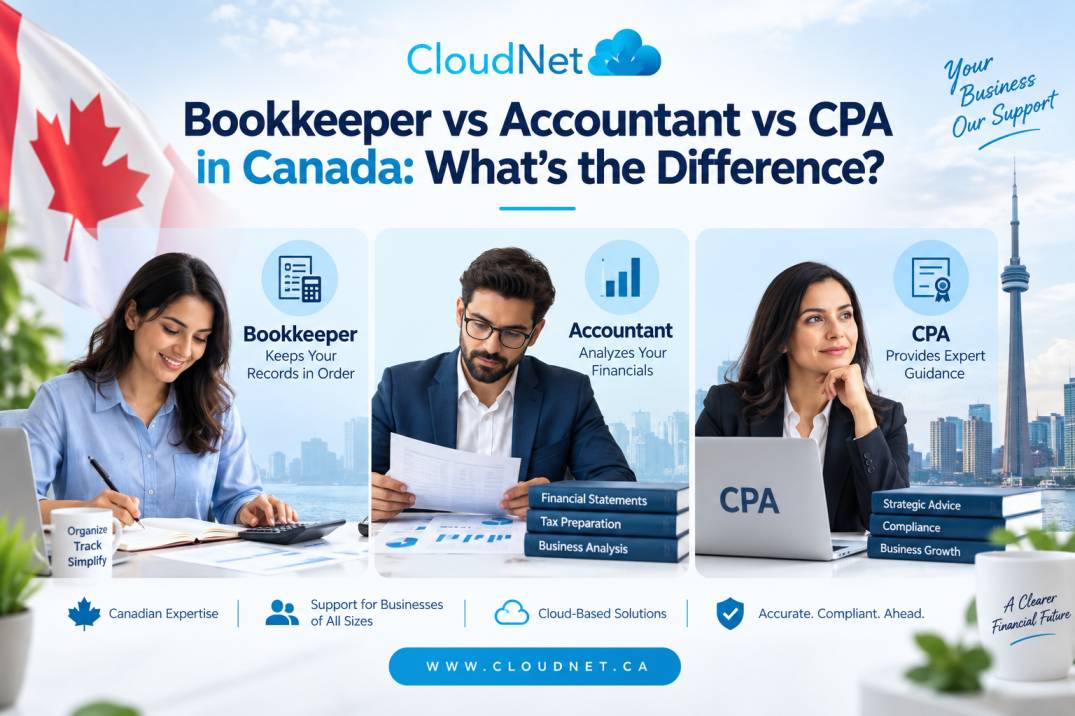
A bookkeeper handles the day-to-day recording of your finances — transactions, reconciliations, payroll processing. An accountant takes that finished record and turns it into financial statements, tax filings, and advice. A CPA (Chartered Professional Accountant) is a licensed, regulated accountant who can do everything an accountant does, plus some things only a CPA is legally permitted to do. Most Canadian businesses use a bookkeeper for the monthly work and an accountant or CPA for the year-end and tax return the two roles work in sequence, not in competition.
Here’s the part that surprises a lot of business owners: “bookkeeper” and “accountant” are not protected titles in Canada. Anyone can call themselves either one and start charging tomorrow. “CPA” is the only legally protected, regulated designation in this list — controlled by provincial bodies, and using the title without being a member is an offence.
That one fact reframes the whole comparison. The real question isn’t “which title sounds more senior” — it’s “which of these can legally do what I need, and which one should I trust with the parts of my finances that carry real consequences.”
What does a bookkeeper actually do?
A bookkeeper records and organizes your business’s day-to-day financial transactions the ongoing, operational work your books need every month. In Canada, bookkeeping is not a regulated profession, so the quality and training of bookkeepers varies, and it’s worth assessing the person rather than the title alone.
A bookkeeper’s typical monthly work looks like:
- Recording income and expenses in your accounting software (QuickBooks, Sage, Xero)
- Reconciling bank and credit card accounts against your statements
- Tracking accounts receivable and accounts payable
- Processing payroll and the related CPP, EI, and tax remittances
- Filing GST/HST returns on schedule
- Producing monthly reports — profit & loss, balance sheet, cash flow
Bookkeeping is not a legislated title in Canada. There’s no license required, no protected designation, no minimum education. Some bookkeepers pursue a voluntary credential like the Certified Professional Bookkeeper (CPB) designation; many are excellent without one. But the title alone tells you nothing about training or reliability — unlike “CPA,” which guarantees a specific standard.
What a bookkeeper generally cannot do: prepare financial statements to a formal accounting standard, provide tax planning advice, or sign off on anything requiring professional accounting judgment. That’s not a knock on bookkeepers — it’s simply outside the scope of the role, by design. Clean bookkeeping is what makes everything an accountant or CPA does afterward possible.
What does an accountant do?
An accountant takes the finished, reconciled records a bookkeeper produces and does the work that depends on them — preparing financial statements, filing tax returns, and advising on financial decisions. Like “bookkeeper,” the plain title “accountant” is not legally protected in Canada — only the CPA designation is.
Where a bookkeeper lives in the current month, an accountant works on the closed year and on what comes next:
- Preparing financial statements from the bookkeeper’s records
- Filing corporate (T2) or personal tax returns
- Tax planning — timing decisions, deductions, structuring
- Advising on bigger financial decisions: a major purchase, salary vs. dividends, business structure
Here’s the catch worth understanding: someone can call themselves an “accountant” without holding any accounting credential at all. In Canada, the regulated professional designation is CPA — Chartered Professional Accountant. Since the 2014 unification of the CA, CGA, and CMA designations, CPA is the sole professional accounting credential in the country. An “accountant” without the CPA letters after their name may be well-qualified — but the title itself isn’t a guarantee the way “CPA” is.
What does a CPA do and why does the designation matter so much?
CPA stands for Chartered Professional Accountant — the one legally regulated accounting designation in Canada, granted and policed by provincial bodies (CPA Ontario, CPA British Columbia, the Ordre des CPA du Québec, and so on). A CPA can do everything an accountant does, and holds the exclusive legal authority to sign certain reports — audit and review engagements — that no unlicensed accountant or bookkeeper can provide.
This is where the “who do I actually need” question gets a concrete answer, because some engagements are legally reserved for CPAs specifically:
- Audit and review engagements — formal assurance reports on financial statements. These can only be signed by a CPA holding a public accounting licence. No licence, no report.
- Compilation engagements — the standard year-end financial statements most incorporated small businesses need. These carry no formal assurance, but a CPA firm prepares them under a professional standard, and they’re what lenders typically expect alongside a corporate tax return.
Provincial CPA bodies hold members to professional standards, ethics rules, continuing education requirements, and a formal discipline process. That’s the real weight behind the three letters: if something goes wrong, there’s a body that can investigate and discipline a CPA. There’s no equivalent for an unregulated “accountant” or “bookkeeper.”
Practically: anyone can technically prepare a T2 corporate tax return. The real question is who stands behind the numbers if the CRA — or your bank — starts asking questions
So who does your business actually need?
Most Canadian businesses need a bookkeeper for the monthly work, and an accountant or CPA for the year-end and the tax return. Whether you specifically need a CPA rather than a general accountant comes down to one thing: does your situation require a legally reserved service — an audit, a review engagement, or the kind of financial statements a lender or investor will insist come from a CPA firm?
A practical way to think about it:
You likely just need a bookkeeper if:
- You’re a sole proprietor or very small operation
- Your books are straightforward
- You mainly need clean, current records and GST/HST filed on time
You need a bookkeeper plus an accountant (not necessarily a CPA) if:
- You’re incorporated and need a T2 filed
- You want tax planning advice beyond basic filing
- Your situation doesn’t involve a lender or investor demanding CPA-prepared statements
You need a CPA specifically if:
- A bank, investor, or contract requires audited or reviewed financial statements
- You want a professional bound by provincial standards and a discipline process
- Your business has grown complex enough that the advice — not just the filing — is where the real value is
For most incorporated small businesses, the practical setup is a bookkeeper handling the monthly work feeding into a CPA firm that prepares the year-end statements and the T2 together — since those year-end numbers are what set the tax bill. The two roles genuinely complement each other rather than compete; neither replaces the other. (If your bookkeeper or CPA is still working on QuickBooks Desktop and you’re weighing what that setup costs to run well, our QuickBooks hosting cost breakdown covers that separately.)
Roughly what does each cost?
Costs vary by province, business complexity, and whether you hire in-house or outsource, but as a general shape:
- Bookkeeping — typically billed monthly or hourly; outsourced bookkeeping is often the most accessible entry point for a small business.
- Accountant (non-CPA) services — tax filing and basic planning, usually priced per engagement or by the return.
- CPA firm services — year-end statements, T2 filing, and any assurance work generally carry a premium over non-CPA accounting, reflecting the licence, the standards the work is held to, and the liability the CPA carries by signing it.
Confirm current rates with providers in your area — they vary meaningfully by province and by the complexity of your business — but budgeting for bookkeeping as an ongoing monthly cost and accounting/CPA work as a periodic, year-end cost is the right mental model for most small businesses.
Where this gets practical: bookkeeper, accountant, and CPA usually need to work in the same books?
One thing that doesn’t come up in most comparisons of these roles: in practice, your bookkeeper’s monthly work and your accountant or CPA’s year-end work both depend on the same company file. If your bookkeeper is entering transactions in QuickBooks or Sage all year, and your CPA needs to review that same file at year-end sometimes from a different office entirely — how easily they can both get into it matters more than people expect.
This is a genuinely common friction point. A bookkeeper working in-house, a CPA firm working from their own office, and sometimes a business owner who wants visibility too — all needing the same file, often not all in the same building. Emailed copies of the company file, mismatched versions, or a CPA firm waiting for access at the exact moment they need it during tax season are common, avoidable headaches.
It’s not the focus of this article, but it’s worth knowing: businesses that host their QuickBooks or Sage file in the cloud generally solve this without thinking about it — the bookkeeper, the business owner, and the accounting or CPA firm can all access the same, current file from wherever they’re working, without emailing anything back and forth. If that’s a friction point your business already has, it’s a solvable one. We’ve written more about how QuickBooks hosting and Sage hosting work for exactly this kind of multi-party access.
Frequently asked questions
Here we are sharing some of the common questions that are being asked by people
Is “accountant” a protected title in Canada? No. Unlike “CPA,” the plain title “accountant” is not legally regulated in Canada — anyone can use it. The only protected, regulated accounting designation is CPA (Chartered Professional Accountant), controlled by provincial bodies.
Is “bookkeeper” a regulated profession in Canada? No. There’s no legal requirement, license, or standardized education to call yourself a bookkeeper in Canada. Some bookkeepers pursue a voluntary credential like the CPB (Certified Professional Bookkeeper) designation, but it isn’t required.
Can a bookkeeper prepare my year-end financial statements? Generally no. Preparing financial statements to a formal accounting standard, and any assurance work (audits or reviews), falls within the scope of accountants and specifically CPAs — not bookkeeping services.
Do I need a CPA, or is a regular accountant enough? It depends on what you need. If a bank, investor, or contract requires audited or reviewed financial statements, you need a CPA — that work is legally reserved for licensed CPAs. For routine tax filing and planning without a formal assurance requirement, a qualified accountant (CPA or not) may be sufficient.
What’s the difference between a compilation and a review or audit? A compilation is the standard year-end financial statement most incorporated small businesses get — no formal assurance, but prepared by a CPA firm under a professional standard, and what lenders typically expect. Review and audit engagements provide increasing levels of formal assurance and can only be signed by a CPA holding a public accounting licence.
Can I use a bookkeeper and an accountant together? Yes — this is the standard, recommended setup for most incorporated Canadian small businesses. The bookkeeper keeps the books current monthly; the accountant or CPA firm uses that clean record to prepare year-end statements and file taxes. The two roles are designed to work in sequence.
The bottom line
In everyday conversation, “bookkeeper,” “accountant,” and “CPA” often get used as if they’re interchangeable — but in Canada, only one of those titles is actually regulated. A bookkeeper keeps your day-to-day records current. An accountant turns those records into statements and returns. A CPA is a licensed, regulated professional who can do everything an accountant does, plus the assurance work — audits and reviews — that only a CPA is legally permitted to sign.
For most Canadian small businesses, the practical answer is both: a bookkeeper for the monthly work, and an accountant or CPA for the year-end. Which one you need for the year-end usually comes down to whether anyone — a bank, an investor, a contract — is going to ask for financial statements a CPA specifically has to stand behind.
Whichever combination your business uses, if keeping your bookkeeper, your accountant, and your own team working smoothly in the same QuickBooks or Sage file is a challenge, that’s something we help with directly. Talk to us about hosting your books in the cloud so everyone who needs access — in-house or outside your office — has it, securely, from wherever they’re working.